
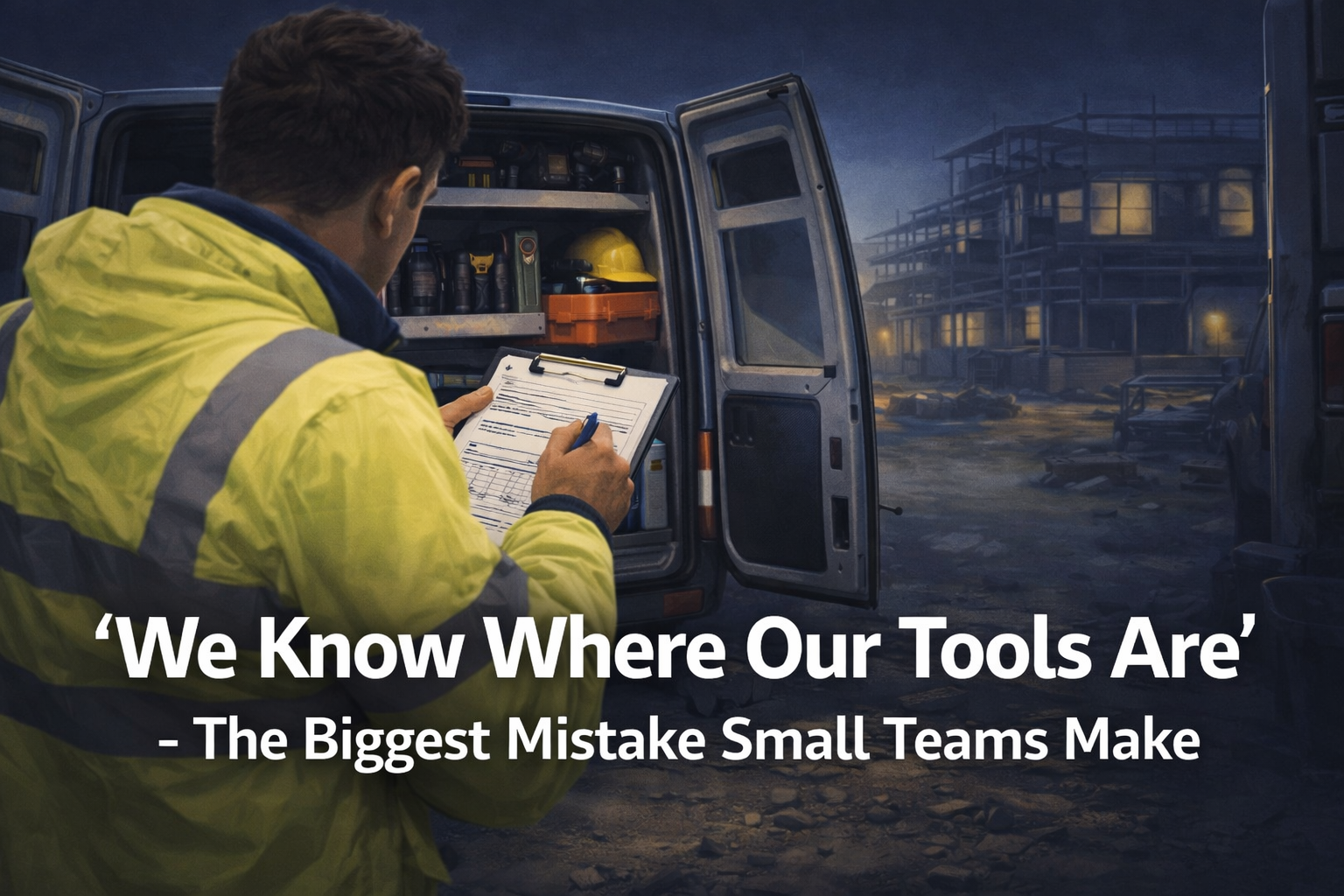
“We Know Where Our Tools Are” — The Biggest Mistake Small Teams Make
It’s something a lot of trade businesses say:
“We know where our tools are.”
And most of the time, it probably feels true.
You know who usually has what.
You know which van the bigger kit is in.
You know where the rest is meant to be.
Until one day, something is missing.
Then the guessing starts.
Who had it last?
Was it left on site?
Is it in another van?
Did someone borrow it?
Was it stolen?
That’s the problem with informal tool tracking. It works right up until the moment it doesn’t.
Why small teams rely on memory
For small trade businesses, it’s normal to keep things informal.
You might only have a few people.
You work closely together.
You trust your team.
And it feels easier to just remember who has which tools rather than create a proper system.
That makes sense in the short term.
But as the business grows, jobs overlap, tools move between vans, and more people use the same equipment, memory becomes less reliable.
Not because anyone is careless.
Just because there’s no clear record.
The problem with “roughly knowing”
Roughly knowing where tools are is not the same as actually tracking them.
If tools are not logged properly, you can run into problems like:
wasted time searching for missing tools
duplicate purchases
delays on site
confusion over who last had something
no clear proof if a tool is lost or stolen
These issues are easy to ignore when they happen occasionally.
But over time, they add up.
And in a busy trade business, even small bits of lost time can turn into real cost.
Why informal systems break down
Most informal systems rely on good memory, good habits, and good communication.
The trouble is, all three can fail under pressure.
A tool gets borrowed and not mentioned.
A van gets unloaded in a rush.
A job runs over and kit gets left behind.
Someone assumes another person has already put something back.
None of this is unusual.
That’s exactly why informal systems break down so easily. They depend on people remembering every movement of every tool — and that just isn’t realistic.
The hidden cost of not knowing
When businesses do not know exactly what tools they have and where they are, the cost is not always obvious straight away.
It often shows up in ways like:
time lost checking vans and stores
jobs slowed down because the right tool is missing
frustration across the team
unnecessary replacements
poor accountability
And when a tool genuinely is stolen or lost, the lack of a proper record makes recovery much harder.
What good tool tracking actually looks like
A good tool tracking system does not need to be complicated.
It just needs to give you clear answers to simple questions:
What tools do we own?
Where are they meant to be?
Who is responsible for them?
Do we have proof of ownership?
Has anything been marked missing, damaged, or stolen?
That’s what many small teams are missing.
Not more admin.
Just more clarity.
Simple ways to improve tool accountability
If your business has been relying on memory, the best place to start is with the basics.
1. Create a central tool register
List the tools your business owns, especially the valuable and frequently used ones.
2. Record key details
Include brand, model, serial number, and any proof of purchase you have.
3. Assign responsibility
Even if tools move around, it helps to know who currently has them or where they should be stored.
4. Keep records in one place
Scattered notes, WhatsApp messages, and paper receipts are hard to rely on when you need answers quickly.
5. Update the system regularly
A tool register only works if it stays current.
Why this matters more as your business grows
The bigger the team, the more chance there is for tools to move around without a clear trail.
Even adding one more van or one more employee increases the risk of things slipping through the cracks.
That’s why tool tracking is not just for large companies.
In many ways, small teams need it more — because one missing tool can have a much bigger impact on the day’s work.
A better way to stay organised
Most trade businesses do not need a complicated asset management system.
They just need a simple way to keep records straight.
Tools like ToolSafe are designed to help with exactly that — giving tradespeople one place to register tools, store proof of ownership, and keep track of what is where.
Final thought
Saying “we know where our tools are” feels fine when everything is where it should be.
But when something goes missing, you quickly find out whether you really knew — or whether you were guessing.
A proper tool tracking system does not just help when things go wrong.
It helps stop small problems becoming expensive ones.
Get started
If you want a simple way to keep tools organised and improve accountability in your business, take a look at ToolSafe: